

Introduction
Australian businesses are under pressure to improve productivity, reduce costs and deliver better customer experiences. AI is becoming a practical way to achieve these goals. From small service companies to larger enterprises, organizations are using AI to automate repetitive work, analyze data and support faster decisions.
This guide covers the top AI use cases for Australian businesses in 2026. It is designed for business owners, managers and decision-makers who want to understand where AI can create real value.
Customer Support Automation
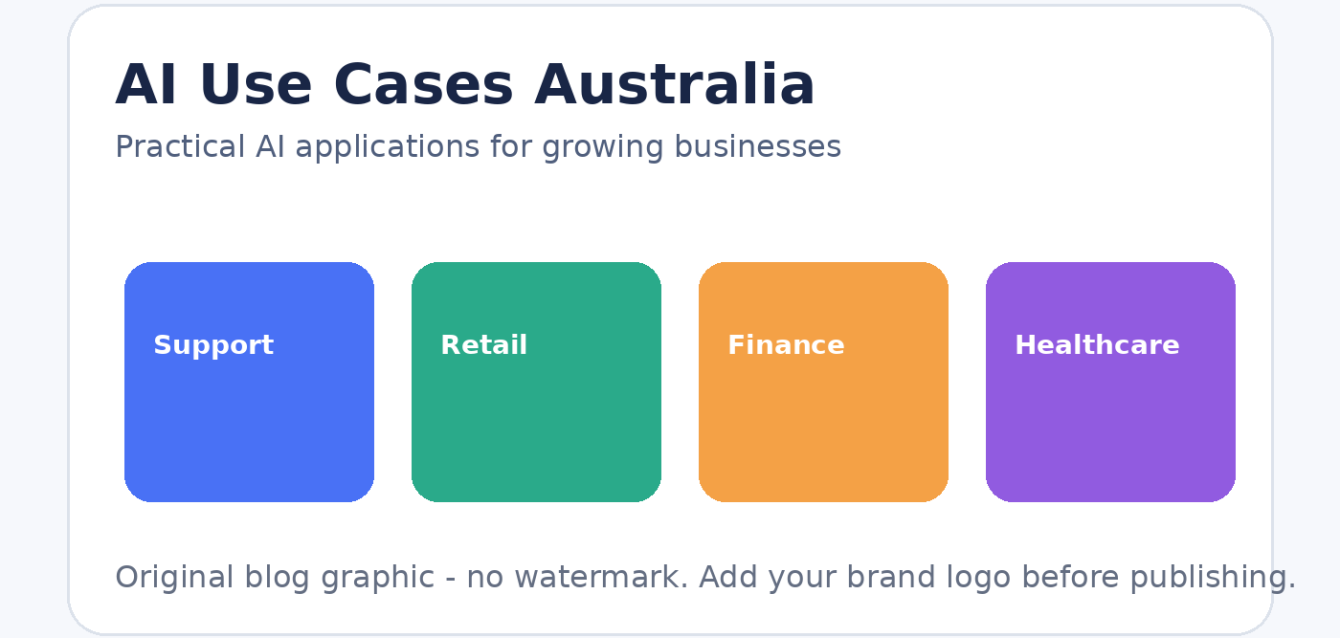
Customer support is one of the most common and practical AI use cases. AI chatbots can answer frequently asked questions, collect customer details, recommend next steps and route complex cases to human agents.
For Australian businesses serving customers across different time zones, AI support tools can provide 24/7 responses without requiring a larger support team. This improves customer experience and reduces response time.
AI for Retail and E-commerce
Retailers can use AI to personalize product recommendations, predict demand, optimize pricing and analyze customer behavior. These use cases help businesses improve conversion rates and reduce wasted inventory.
For e-commerce companies, AI can recommend products based on browsing history, previous purchases and customer preferences. It can also help identify abandoned cart patterns and improve promotional campaigns.
AI in Finance and Professional Services
Finance teams can use AI for fraud detection, invoice processing, expense analysis, risk scoring and forecasting. Professional service firms can use AI to summarize documents, analyze client data and automate reporting.
The main benefit is speed. AI can process large amounts of information faster than manual review. This helps teams make better decisions and spend more time on strategic work.
AI in Healthcare and Wellness
Healthcare and wellness businesses can use AI for appointment scheduling, patient communication, document processing, data analysis and operational planning. AI can also help clinics identify trends in bookings, cancellations and patient needs.
Because healthcare involves sensitive information, AI systems must be designed with privacy and compliance in mind. Businesses should choose solutions that protect data and support human oversight.
AI for Logistics and Operations
Logistics companies can use AI to optimize delivery routes, forecast demand, track inventory and identify operational delays. These tools help reduce costs and improve service reliability.
For businesses managing supply chains, AI can highlight patterns that may not be obvious through manual analysis. This helps teams respond earlier to potential issues.
AI for Sales and Marketing
Sales teams can use AI to score leads, personalize outreach, summarize customer conversations and forecast revenue. Marketing teams can use AI to analyze campaigns, generate content ideas and segment audiences.
The biggest advantage is focus. AI can help teams identify which customers are more likely to convert, which messages perform best and where marketing spend should be adjusted.
AI for Internal Productivity
AI is also useful inside the business. Internal AI assistants can answer employee questions, search company documents, summarize meetings and automate repetitive administrative tasks.
This can save hours each week across departments such as HR, operations, finance and customer service. For many Australian businesses, productivity improvement is one of the strongest reasons to adopt AI.
How Australian Businesses Should Start With AI
The best approach is to start with one clear problem. Choose a use case that is repetitive, time-consuming and measurable. Examples include reducing support tickets, speeding up document processing or improving sales lead qualification.
After selecting the use case, review available data, define success metrics and launch a small pilot. If the pilot works, expand the solution across more teams or workflows.
Conclusion
AI offers Australian businesses a practical path to improve productivity, reduce costs and compete more effectively. The strongest use cases include customer support, retail personalization, finance automation, healthcare operations, logistics optimization and sales intelligence.
The key is to start small, measure results and scale responsibly. If your business is ready to explore AI, Nuclieos can help you identify the right use case and build a solution that supports your growth.
FAQ Section
What are the best AI use cases for Australian businesses?
The best use cases include customer support automation, retail personalization, finance automation, healthcare operations and logistics optimization.
How should a business start using AI?
Start with one measurable problem, launch a small pilot, track ROI and then scale the solution.
Can small businesses in Australia use AI?
Yes. Small businesses can start with affordable AI tools such as chatbots, automated reporting and customer data analysis.