

AI Business Automation Sydney: How Companies Are Reducing Operational Complexity
Across Australia, businesses are under increasing pressure to operate faster, scale efficiently, and reduce operational overhead.
The problem is:
most companies are still heavily dependent on:
- manual workflows
- repetitive tasks
- disconnected systems
- inefficient operational processes
This is one of the key reasons demand for AI business automation in Sydney is growing rapidly.
Businesses are no longer viewing automation as an optional improvement.
They are investing in automation because operational inefficiency now directly impacts:
- profitability
- scalability
- customer experience
- growth speed
- competitive advantage
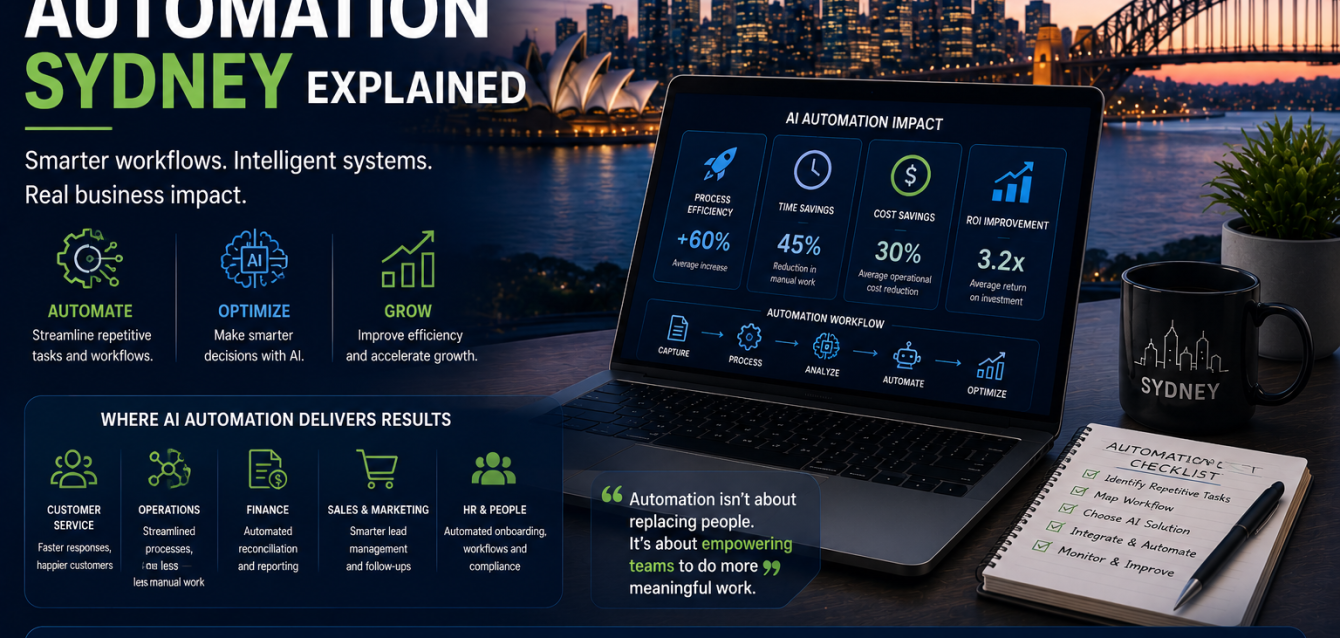
AI-powered automation allows organizations to:
- reduce manual work
- improve decision-making
- streamline operations
- scale more efficiently
In this guide, we break down:
- what AI business automation actually means
- why Sydney businesses are investing heavily in it
- which operational problems automation solves
- how companies are preparing for AI-driven operations
What Is AI Business Automation?
AI business automation refers to the use of artificial intelligence and intelligent systems to automate operational processes that previously required manual human involvement.
Unlike traditional automation, AI-driven systems can:
- analyze data
- make decisions
- optimize workflows
- adapt dynamically
This allows businesses to automate far more complex processes than traditional software systems.
Why Businesses in Sydney Are Prioritizing AI Automation
Sydney businesses are increasingly investing in AI-powered systems because operational complexity has grown significantly over the past decade.
Modern businesses now manage:
- multiple software platforms
- growing data volumes
- distributed teams
- increasing customer expectations
Without automation, operations become:
- slower
- more expensive
- difficult to scale
This is why companies are actively exploring AI business automation in Sydney to improve operational efficiency.
Rising Operational Costs
One major driver behind automation is increasing operational cost.
Manual processes:
- consume employee time
- increase human error
- slow business operations
AI automation reduces these inefficiencies by automating repetitive and time-consuming tasks.
Need for Faster Decision-Making
Businesses now require:
- real-time insights
- faster responses
- predictive analytics
AI systems help organizations process large volumes of operational data quickly and accurately.
Demand for Scalable Operations
As businesses grow, operational complexity increases.
Without automation:
- teams become overloaded
- workflows slow down
- scaling becomes difficult
AI automation enables businesses to scale operations without proportionally increasing operational overhead.
Real Operational Problems AI Automation Solves
Repetitive Administrative Tasks
Many businesses still rely on manual processes for:
- reporting
- approvals
- customer requests
- data entry
AI-powered systems automate these repetitive workflows, significantly improving efficiency.
Fragmented Business Systems
Disconnected systems create:
- duplicated work
- inconsistent data
- poor visibility
Automation platforms help unify operations across:
- CRM systems
- finance platforms
- customer portals
- operational dashboards
👉 Learn how integrated systems improve scalability
Delayed Customer Support and Operations
AI automation helps businesses:
- respond faster
- improve customer experiences
- reduce operational bottlenecks
This is especially valuable in industries where customer responsiveness directly impacts retention.
Industries Driving AI Automation in Sydney
Finance and Fintech
Financial businesses are automating:
- compliance workflows
- fraud detection
- customer onboarding
Healthcare
Healthcare organizations use AI automation for:
- patient workflows
- scheduling systems
- operational reporting
Logistics and Operations
Logistics companies increasingly rely on automation for:
- route optimization
- inventory management
- operational visibility
👉 Example operational optimization
H3: Education and Administration
Educational institutions are modernizing administrative systems through automation.
AI Automation vs Traditional Automation
Traditional automation follows predefined rules.
AI automation goes further by:
- learning from data
- identifying patterns
- adapting workflows dynamically
This makes AI-driven operations significantly more scalable and intelligent.
Common Mistakes Businesses Make with AI Automation
Automating Broken Processes
Automation does not fix poor operational design.
Businesses should first optimize workflows before automating them.
Implementing AI Without Proper Infrastructure
AI systems require:
- structured data
- scalable systems
- integrated workflows
👉 Learn why infrastructure modernization matters
https://nuclieos.com/legacy-system-modernization-sydney/
Choosing Tools Instead of Strategy
Many companies focus only on software tools instead of operational outcomes.
Successful automation starts with:
- business objectives
- workflow analysis
- scalability planning
Real Example: AI Automation Transformation
A Sydney-based operations company struggled with:
- manual approvals
- disconnected systems
- delayed reporting
After implementing AI-driven workflow automation:
- approvals became automated
- reporting became centralized
- operational efficiency improved significantly
The company achieved:
- reduced operational costs
- faster workflows
- better scalability
👉 Similar transformation case study
Why AI Automation Is Becoming a Competitive Advantage
Businesses investing in automation today are creating significant operational advantages.
AI-powered systems allow companies to:
- scale faster
- reduce costs
- improve customer experience
- operate more efficiently
This is why AI business automation in Sydney is rapidly becoming a major strategic priority.
🚀 Build AI-Driven Business Operations
AI automation is no longer limited to enterprise organizations.
Modern businesses of all sizes are investing in intelligent operational systems to improve scalability and efficiency.
If you’re exploring AI business automation in Sydney, focusing on long-term operational strategy is critical.
👉 Explore AI and software development services
👉 Learn more about AI solutions
FAQs
What is AI business automation?
It involves using AI systems to automate operational workflows and decision-making processes.
Why are businesses investing in automation?
To reduce operational costs, improve efficiency, and scale more effectively.
Is AI automation only for large businesses?
No. Businesses of all sizes can benefit from automation and intelligent workflows.