


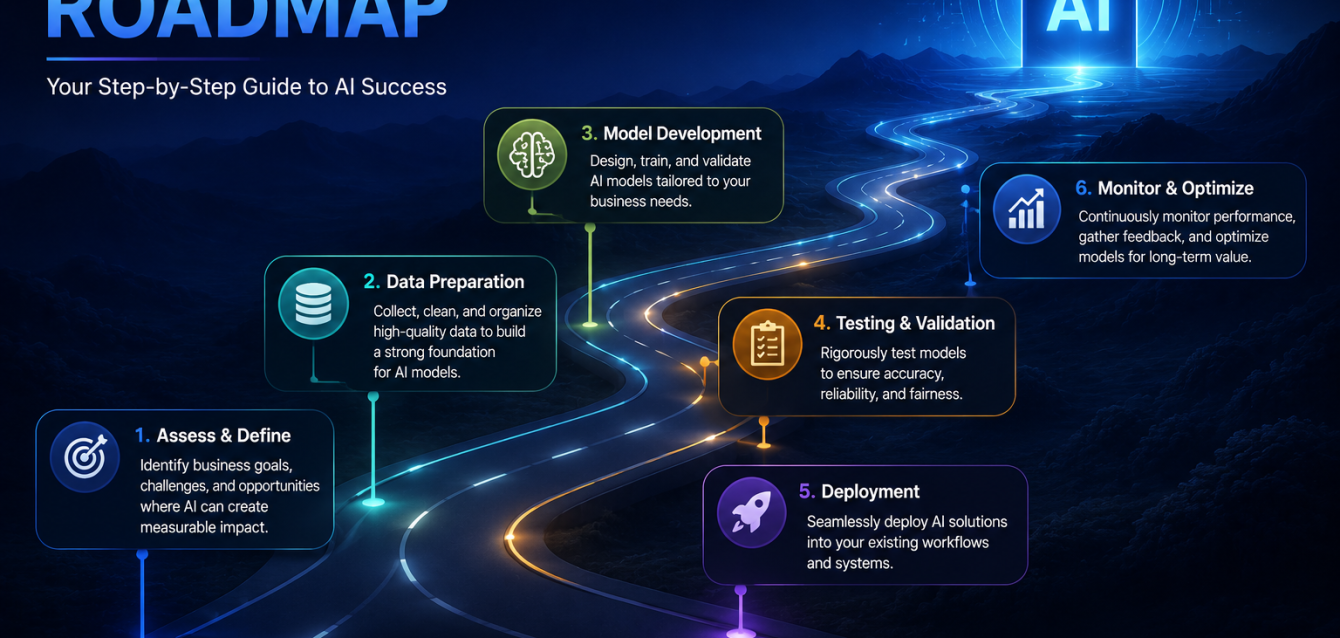
AI Implementation Roadmap: Step-by-Step Guide for Businesses
An effective AI implementation roadmap is the difference between successful AI adoption and failed projects.
Many businesses jump into AI without a plan and face:
- unclear ROI
- integration issues
- wasted investment
A structured AI implementation roadmap helps you:
- align AI with business goals
- reduce risk
- maximize return on investment
In this guide, you’ll learn how to build and execute an AI roadmap step-by-step.
What is an AI Implementation Roadmap?
An AI implementation roadmap is a strategic plan that defines:
- how AI will be adopted
- what solutions will be built
- how systems will scale
It ensures:
👉 structured execution instead of guesswork
Why Businesses Need an AI Implementation Roadmap
1. Avoid Costly Mistakes
Without a roadmap:
❌ wrong use cases
❌ wasted resources
2. Align AI with Business Goals
AI should solve:
- real problems
- measurable outcomes
3. Ensure Scalability
A roadmap prepares your system for:
- growth
- future expansion
Step-by-Step AI Implementation Roadmap
Step 1: Identify Business Objectives
Start with:
👉 “What problem are we solving?”
Examples:
- reduce costs
- automate tasks
- improve customer experience
Step 2: Identify High-Impact AI Use Cases
Focus on:
- quick wins
- measurable ROI
Step 3: Assess Data Readiness
AI depends on data.
Evaluate:
- data quality
- data availability
- data structure
Step 4: Choose AI Approach
Options:
- custom AI solutions
- off-the-shelf AI tools
Step 5: Select Technology & Architecture
Define:
- tech stack
- infrastructure
- system design
Step 6: Develop AI Model & System
This includes:
- model training
- testing
- deployment
Step 7: Integrate with Existing Systems
AI must connect with:
- CRM
- ERP
- workflows
Step 8: Monitor & Optimize
After launch:
- track performance
- retrain models
- improve accuracy
AI Implementation Timeline
Typical timeline:
- Planning: 2–4 weeks
- Development: 2–6 months
- Optimization: ongoing
Real Example (Business Case)
Manufacturing Company
Goal:
- reduce defects
Solution:
- AI quality detection
Result:
- 35% defect reduction
- improved efficiency
- ROI in 8 months
Common AI Implementation Mistakes
1. No Clear Strategy
Leads to:
❌ random AI projects
2. Ignoring Data Issues
Bad data = bad AI
3. Overcomplicating Early
Start simple → scale later
4. Choosing Wrong Partner
Cost Considerations in AI Implementation
Costs include:
- development
- infrastructure
- maintenance
🚀 Build a Successful AI Implementation Strategy
A strong AI implementation roadmap ensures:
- faster adoption
- lower risk
- higher ROI
👉 Explore AI development services:
FAQs
What is an AI implementation roadmap?
A step-by-step plan to adopt and scale AI solutions.
How long does AI implementation take?
2–6 months depending on complexity.
What is the first step in AI implementation?
Define clear business objectives.