

Introduction
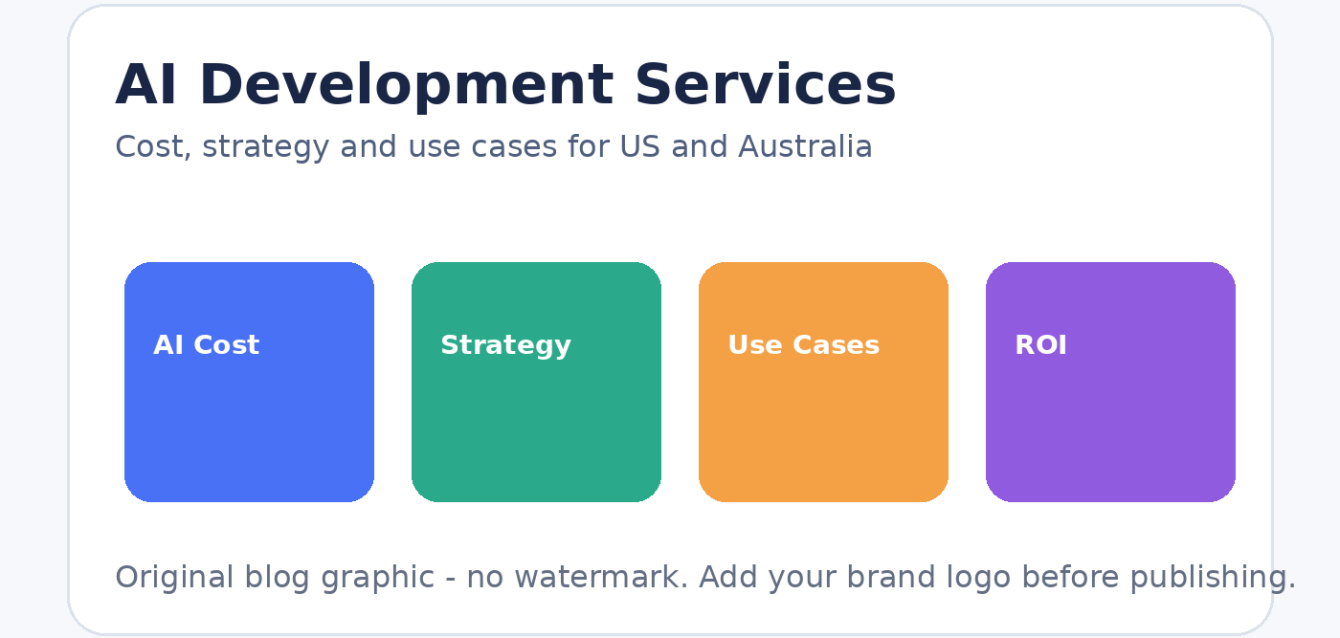
Artificial intelligence is no longer only for large technology companies. Businesses in the United States and Australia are using AI to reduce manual work, improve customer service, analyze data faster and make better decisions. For many companies, the question is no longer whether AI can help. The real question is how much AI development costs, where to start and which use cases can deliver the fastest return.
This guide explains AI development services in simple business terms. It covers expected costs, practical implementation strategy and real-world use cases for industries such as retail, healthcare, finance, education, logistics and customer support. If your business is planning to adopt AI in 2025, this article will help you understand the smartest way to move forward.
What Are AI Development Services?
AI development services help businesses design, build and deploy intelligent software that can automate tasks, learn from data and support decision-making. These services may include machine learning models, AI chatbots, generative AI tools, predictive analytics systems, recommendation engines, computer vision tools and AI-powered business dashboards.
Unlike traditional software, AI systems can improve over time when they are trained with the right data. A standard application follows fixed rules. An AI solution can recognize patterns, predict outcomes and support teams with faster insights. This is why more businesses are investing in custom AI development instead of relying only on off-the-shelf tools.
How Much Do AI Development Services Cost in the US and Australia?
AI development cost depends on project complexity, data quality, integrations, model requirements and long-term support. A simple chatbot will cost much less than a custom enterprise AI platform connected to multiple systems.
As a practical estimate, a basic AI chatbot may cost between USD 8,000 and USD 25,000 in the United States, or roughly AUD 12,000 to AUD 40,000 in Australia. A custom AI solution for automation, analytics or recommendations may range from USD 25,000 to USD 120,000+, or AUD 40,000 to AUD 180,000+. Enterprise AI systems with advanced machine learning, security, compliance and integrations may exceed USD 120,000 to USD 600,000+, or AUD 180,000 to AUD 900,000+.
Key Factors That Affect AI Development Cost
The final cost of an AI project depends on several important factors. The first is data readiness. If your data is clean, organized and accessible, development becomes faster and more affordable. If your data is scattered across spreadsheets, CRMs, support platforms and old systems, more time is needed for preparation.
The second factor is model complexity. A simple rule-based chatbot costs less than a machine learning model that predicts customer churn or detects fraud. Generative AI applications, such as AI assistants or content automation tools, may also require additional work around accuracy, safety and brand tone.
Other cost drivers include third-party integrations, cloud infrastructure, security requirements, testing, maintenance and staff training. Businesses should not only plan for development cost. They should also budget for monitoring, improvements and ongoing optimization after launch.
AI Implementation Strategy for Businesses
The best AI strategy is not to automate everything at once. Successful companies usually start with one high-impact use case, prove value, then expand. This approach reduces risk and helps stakeholders see measurable results early.
A smart AI implementation strategy includes five steps: identify the business problem, check data availability, choose the right AI solution, launch a pilot project and measure ROI. For example, a company may start by automating customer support questions before moving into sales forecasting or internal workflow automation.
The most important point is to connect AI with business goals. AI should not be added just because it is trending. It should solve a real problem such as reducing support tickets, increasing conversions, improving forecasting accuracy, detecting fraud or saving employee time.
Real Business Use Cases for AI Development
Customer Support: AI chatbots and virtual assistants can answer common questions, collect lead information, route tickets and provide 24/7 support. This reduces response time and helps teams focus on complex customer issues.
Retail and E-commerce: AI can recommend products, personalize offers, forecast demand and analyze customer behavior. These tools help improve conversion rates and increase average order value.
Finance: AI can support fraud detection, credit risk analysis, transaction monitoring and financial forecasting. These use cases are valuable because they reduce risk and improve decision-making.
Healthcare: AI can support appointment automation, patient data analysis, medical document processing and diagnostic assistance. Healthcare companies must also consider privacy, compliance and accuracy.
Logistics and Operations: AI can optimize delivery routes, predict demand, track inventory and identify delays before they become major problems.
Human Resources: AI can screen applications, summarize resumes, answer employee questions and analyze workforce trends.
AI vs Traditional Software Development
Traditional software is excellent for fixed workflows. AI is better when a business needs prediction, personalization, pattern recognition or automation based on large amounts of data. For example, a traditional CRM can store customer records, but an AI-powered CRM can predict which leads are most likely to convert.
AI solutions may cost more upfront, but they often create long-term savings by reducing manual work, improving speed and helping teams make better decisions. The right choice depends on the business goal. In many cases, the best solution combines traditional software with AI features.
Why Businesses in the US and Australia Are Investing in AI
The US market is highly competitive, which means businesses need faster operations, better personalization and stronger customer experiences. AI helps companies respond quickly and operate more efficiently.
In Australia, many businesses are adopting AI to improve productivity, reduce operational costs and compete with larger global companies. Sectors such as retail, healthcare, finance, professional services and education can benefit from AI-driven automation and analytics.
For both markets, the biggest advantage is scalability. Once an AI system is properly built, it can process more data, serve more customers and support more teams without increasing headcount at the same rate.
How to Choose the Right AI Development Partner
Choosing the right AI development company is critical. Look for a partner that understands business strategy, not only technology. The right provider should ask about your goals, data, workflows, customers and success metrics before suggesting a solution.
A strong AI partner should offer discovery, data assessment, prototype development, model training, integration, testing, deployment and long-term support. They should also explain risks clearly, including data quality issues, model accuracy, security and maintenance needs.
Conclusion
AI development services can help businesses in the US and Australia reduce costs, improve efficiency and unlock new growth opportunities. The most successful AI projects start with a clear business problem, realistic budget and practical implementation strategy.
Whether your goal is to build an AI chatbot, automate internal workflows, analyze customer data or create a custom AI platform, the best time to start is with a focused pilot project. Start small, measure results and scale what works.
Ready to explore AI for your business? Contact Nuclieos to discuss your goals and discover the right AI solution for your company.
FAQ Section
How much do AI development services cost?
AI development services may cost from USD 8,000 for basic tools to USD 600,000+ for enterprise systems, depending on complexity.
What is the best AI strategy for businesses?
The best strategy is to start with one high-impact use case, measure results and scale gradually.
What are common AI use cases?
Common AI use cases include chatbots, predictive analytics, fraud detection, recommendations, document automation and internal AI assistants.