

Legacy System Modernization Sydney: Why Businesses Are Rebuilding Their Software Stack
Across Australia, businesses are facing a major technology problem that is becoming increasingly difficult to ignore:
👉 legacy systems are slowing growth.
Many organizations still rely on outdated platforms built years ago—systems that were originally designed for a completely different business environment.
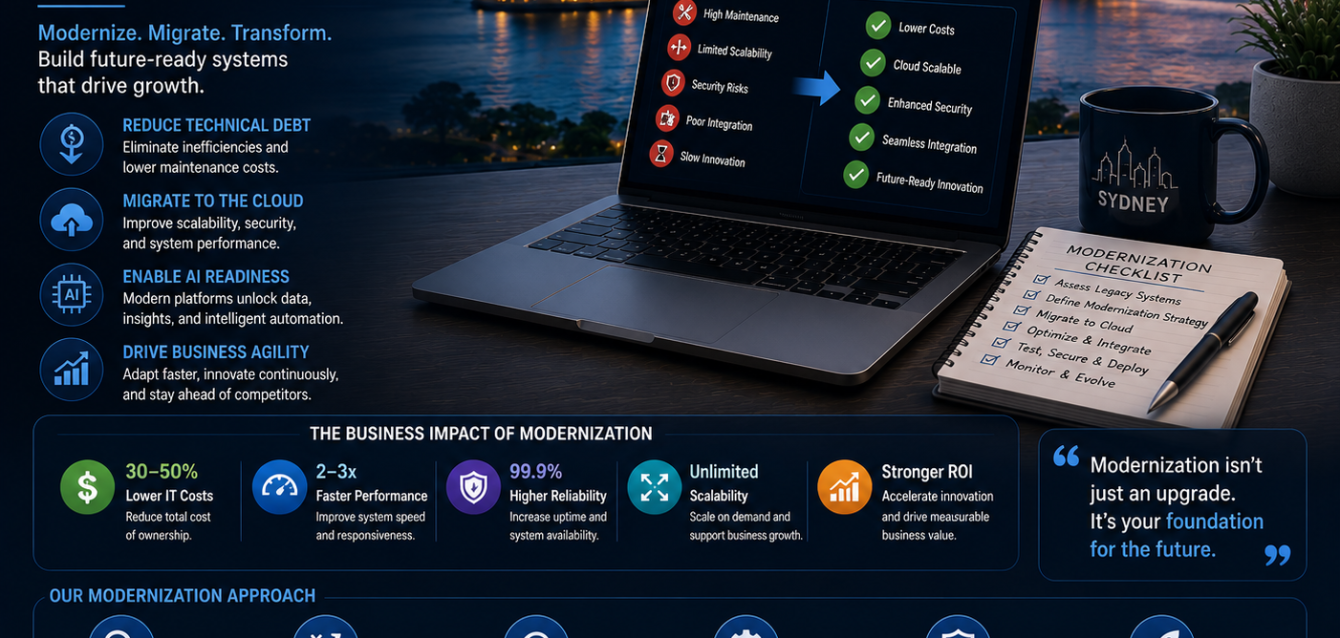
While these systems may still function, they often create hidden operational problems including:
- slow workflows
- integration failures
- security risks
- scalability limitations
- increasing maintenance costs
This is why demand for legacy system modernization in Sydney is growing rapidly.
Businesses are no longer modernizing software simply to “upgrade technology.” They are modernizing because outdated systems now directly impact:
- operational efficiency
- customer experience
- business scalability
- AI readiness
- competitive advantage
In this guide, we break down:
- why legacy systems are becoming a business risk
- what modernization actually involves
- common mistakes businesses make
- how Sydney companies are rebuilding their software infrastructure for long-term growth
What Is Legacy System Modernization?
Legacy system modernization is the process of upgrading outdated software systems, infrastructure, and workflows to align with modern business and technology requirements.
This can involve:
- rebuilding software architecture
- migrating systems to the cloud
- improving integrations
- redesigning workflows
- replacing outdated technologies
The goal is not simply to create “new software.”
The real goal is to build systems that:
- scale efficiently
- support automation
- improve operational visibility
- integrate with modern technologies including AI and cloud platforms
Why Legacy Systems Are Becoming a Major Business Problem
Many businesses delay modernization because existing systems still appear functional.
However, the hidden costs of outdated software are often substantial.
Operational Inefficiencies Increase Over Time
Legacy systems frequently require:
- manual processes
- duplicate data entry
- disconnected workflows
Over time, these inefficiencies compound and reduce productivity across the organization.
Businesses often don’t realize how much time and revenue is lost until modernization begins.
Integration Challenges with Modern Platforms
Modern businesses depend on:
- CRMs
- cloud infrastructure
- analytics platforms
- AI-powered tools
- automation systems
Older systems typically struggle to integrate with these technologies.
This creates:
- fragmented data
- inconsistent reporting
- operational bottlenecks
Technical Debt Becomes Expensive
Technical debt refers to the long-term cost created by outdated architecture, poor scalability, and short-term development decisions.
As technical debt increases:
- maintenance becomes expensive
- changes become slower
- system reliability decreases
This is one of the main reasons businesses begin investing in enterprise software modernization.
Why Sydney Businesses Are Prioritizing Modernization
Sydney businesses are facing increasing pressure to modernize due to growing competition and rapid digital transformation.
Organizations now require:
- scalable infrastructure
- real-time data visibility
- workflow automation
- AI readiness
Without modernization, businesses struggle to compete effectively.
AI and Automation Require Modern Infrastructure
One of the biggest drivers behind modernization is AI adoption.
AI systems require:
- structured data
- connected systems
- scalable infrastructure
Legacy systems often lack these foundations.
This means businesses attempting to implement AI without modernization frequently encounter:
- poor data quality
- integration failures
- limited automation capabilities
👉 Learn how businesses are implementing AI-driven systems
Cloud Migration Is Accelerating
Many Sydney businesses are moving away from on-premise infrastructure toward cloud-native environments.
Cloud modernization improves:
- scalability
- security
- deployment speed
- operational flexibility
Common Signs Your Business Needs Legacy System Modernization
Systems Are Slow and Difficult to Maintain
If small changes require significant effort, your architecture is likely outdated.
Teams Depend on Manual Workarounds
Manual spreadsheets, duplicate systems, and disconnected workflows are major warning signs.
Reporting and Data Visibility Are Poor
Businesses relying on outdated systems often struggle with:
- inaccurate reporting
- delayed insights
- fragmented data
Scalability Is Becoming a Problem
Legacy systems often fail as:
- customer volume increases
- operations expand
- integrations grow more complex
What Legacy Modernization Actually Involves
Modernization is not always a complete rebuild.
In many cases, businesses modernize incrementally.
Re-Architecting Core Systems
This involves redesigning:
- backend systems
- databases
- integrations
to support scalability and performance.
Cloud Migration
Moving systems to cloud infrastructure improves:
- flexibility
- resilience
- deployment speed
Workflow Automation
Modernized systems reduce operational overhead through:
- automation
- centralized workflows
- intelligent processes
👉 Example of workflow optimization
API and System Integration
Modern businesses require seamless integration across:
- CRM systems
- financial platforms
- analytics tools
- customer systems
Common Mistakes Businesses Make During Modernization
Trying to Modernize Everything at Once
Large-scale rebuilding without prioritization often creates unnecessary risk.
Successful modernization usually happens in stages.
Ignoring Business Processes
Modernization should improve operations—not just technology.
Without operational alignment, businesses often rebuild inefficient systems.
Choosing Short-Term Fixes Instead of Strategic Solutions
Temporary patches may reduce immediate issues but increase technical debt long-term.
Real Example: Sydney Business Modernization
A Sydney-based operations company relied on legacy software built over a decade earlier.
The system created:
- slow workflows
- fragmented reporting
- integration limitations
After modernization:
- workflows became automated
- reporting improved significantly
- operational visibility increased
- infrastructure scaled more efficiently
👉 Similar operational transformation
Why Modernization Is a Long-Term Competitive Advantage
Businesses investing in modernization today are preparing for:
- AI adoption
- scalable growth
- operational efficiency
- future digital transformation
Modern systems enable companies to move faster, automate more effectively, and adapt to changing market conditions.
🚀 Modernize Your Software Infrastructure for Growth
Legacy systems may still function, but they often limit long-term scalability and innovation.
If your business is evaluating legacy system modernization in Sydney, focusing on scalability, integration, and future readiness is critical.
👉 Explore software modernization services
👉 Learn more about the development team
FAQs
What is legacy system modernization?
It is the process of upgrading outdated software systems to improve scalability, integrations, and efficiency.
Why are businesses modernizing legacy systems?
Because outdated systems create operational inefficiencies, security risks, and scalability limitations.
Is modernization better than rebuilding?
In many cases, incremental modernization is more cost-effective and less risky than rebuilding everything from scratch.