

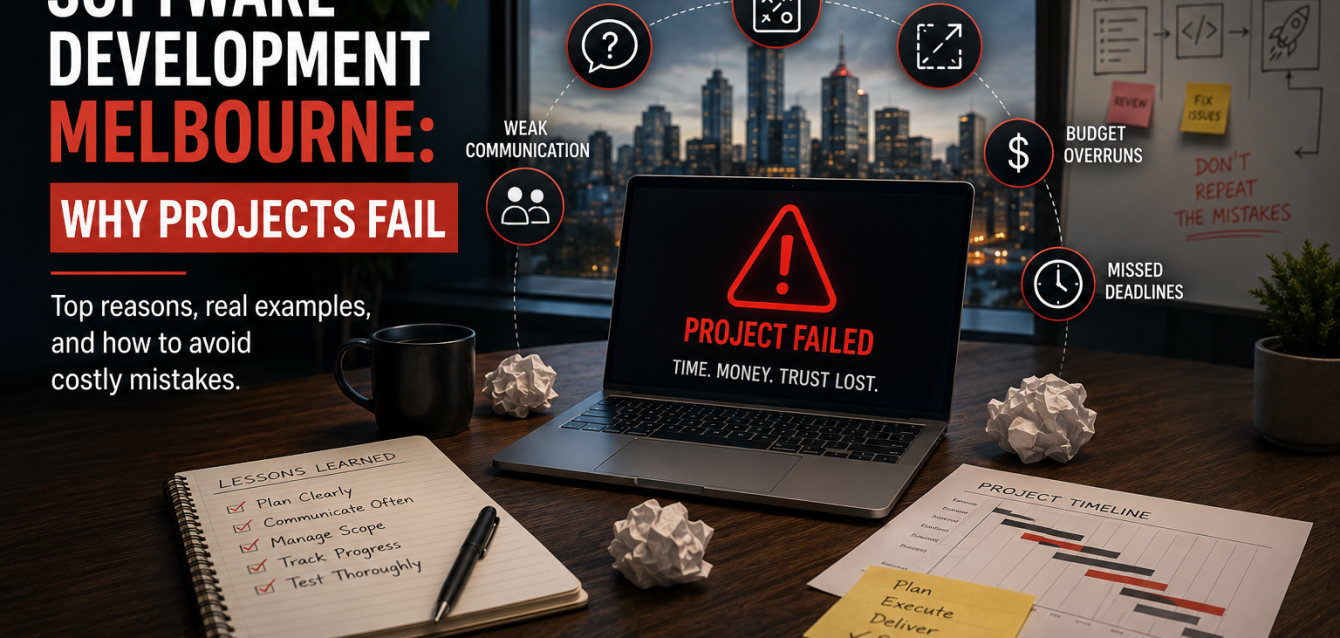
Software Development Melbourne: Why Most Projects Fail (And How to Avoid It)
If you’re investing in software development in Melbourne, there’s something most agencies won’t tell you upfront:
👉 A large percentage of software projects fail — not because of bad ideas, but because of poor execution.
Businesses across Melbourne spend anywhere between $20,000 to $150,000+ on software projects, expecting improved efficiency, automation, or scalability. Yet many end up with delayed timelines, unusable systems, or products that fail to deliver business value.
Understanding why these failures happen is the key to avoiding them. In this guide, we break down real-world reasons behind failed software development projects in Melbourne—and more importantly, how to ensure your project succeeds.
The Reality of Software Development in Melbourne
Melbourne has become one of Australia’s leading technology hubs, with a growing number of startups, enterprises, and digital-first businesses investing in custom software solutions. However, with increased demand comes increased risk.
Many companies assume that hiring a development agency is enough to guarantee success. In reality, software development is a complex, multi-layered process involving planning, communication, architecture, and long-term strategy.
The biggest issue is not a lack of developers—but a mismatch between business expectations and technical execution.
7 Reasons Software Development Projects Fail in Melbourne
1. Lack of Clear Business Objectives
One of the most common reasons software projects fail is the absence of clearly defined goals. Many businesses start with a vague idea such as “we need a system” or “we want automation,” without identifying the exact problem they want to solve.
Without clarity:
- requirements constantly change
- developers build incorrect features
- timelines extend indefinitely
Successful projects always begin with a well-defined problem and measurable outcomes.
2. Choosing the Wrong Software Development Company
Not every agency offering software development in Melbourne has the capability to deliver high-quality, scalable solutions.
Some agencies:
- outsource most of their work
- lack experience in complex systems
- rely on outdated technologies
Choosing the wrong partner often results in:
- poor code quality
- delays
- increased long-term costs
👉 A structured evaluation approach is critical
3. Underestimating Project Complexity
Software development is not just coding—it involves:
- system architecture
- integrations
- database design
- performance optimization
Businesses often underestimate how these factors impact time and cost. What seems like a “simple system” can quickly evolve into a complex product requiring multiple iterations.
4. Poor Communication Between Stakeholders
A major failure point in software projects is communication gaps between:
- business owners
- project managers
- developers
When communication is weak:
- requirements are misunderstood
- priorities are unclear
- development direction shifts
Regular updates, clear documentation, and collaborative planning are essential for success.
5. Focusing Only on Cost Instead of Value
Many businesses choose a software development company based purely on price. While this may reduce upfront costs, it often leads to:
- poor system performance
- security vulnerabilities
- expensive rework
In software development, the cheapest option is rarely the most cost-effective in the long run.
6. Lack of Scalable Architecture
A system that works for 10 users may fail at 1,000 users.
Without proper architecture:
- performance slows down
- system crashes increase
- scalability becomes expensive
👉 Learn how architecture impacts long-term success
7. No Post-Launch Strategy
Many businesses treat software as a one-time project. In reality, software requires continuous improvement, including:
- updates
- bug fixes
- performance optimization
Without a post-launch plan, even well-built systems degrade over time.
Real Example: Software Failure and Recovery in Melbourne
A Melbourne-based logistics company invested in a custom platform to optimize delivery operations. Initially, they hired a low-cost development team without clearly defining requirements.
The result:
- project delayed by 6 months
- system failed during testing
- additional costs for rework
After reassessing their approach, they partnered with an experienced development company, defined clear objectives, and rebuilt the system.
The outcome:
- successful deployment
- improved delivery efficiency
- scalable system supporting future growth
This example highlights how the right strategy and partner can completely change outcomes.
How to Ensure Software Development Success
Start with a Clear Problem Statement
Define:
- what problem you are solving
- how success will be measured
Choose an Experienced Development Partner
Look for:
- proven experience
- real case studies
- scalable solutions
H3: Plan for Scalability from Day One
Even if your current user base is small, your system should be built to handle growth without major rework.
Focus on Long-Term Value
Instead of asking:
👉 “What is the cheapest option?”
Ask:
👉 “What solution delivers the best long-term ROI?”
Why Melbourne Businesses Are Investing in Custom Software
Despite risks, custom software remains a top choice for businesses because it provides:
- flexibility to adapt to business needs
- better integration with existing systems
- competitive advantage in the market
This is why demand for software development in Melbourne continues to grow across industries.
🚀 Work With a Reliable Software Development Company in Melbourne
Avoiding these common mistakes is essential if you want your software project to succeed.
If you’re planning software development in Melbourne, working with the right partner can save time, cost, and long-term headaches.
👉 Explore professional services:
FAQs
Why do software development projects fail?
Most failures occur due to poor planning, unclear requirements, and choosing the wrong development partner.
How can I avoid software project failure?
Start with clear goals, choose an experienced company, and plan for scalability.
Is custom software development risky?
It can be risky without the right approach, but when done correctly, it delivers significant long-term value.